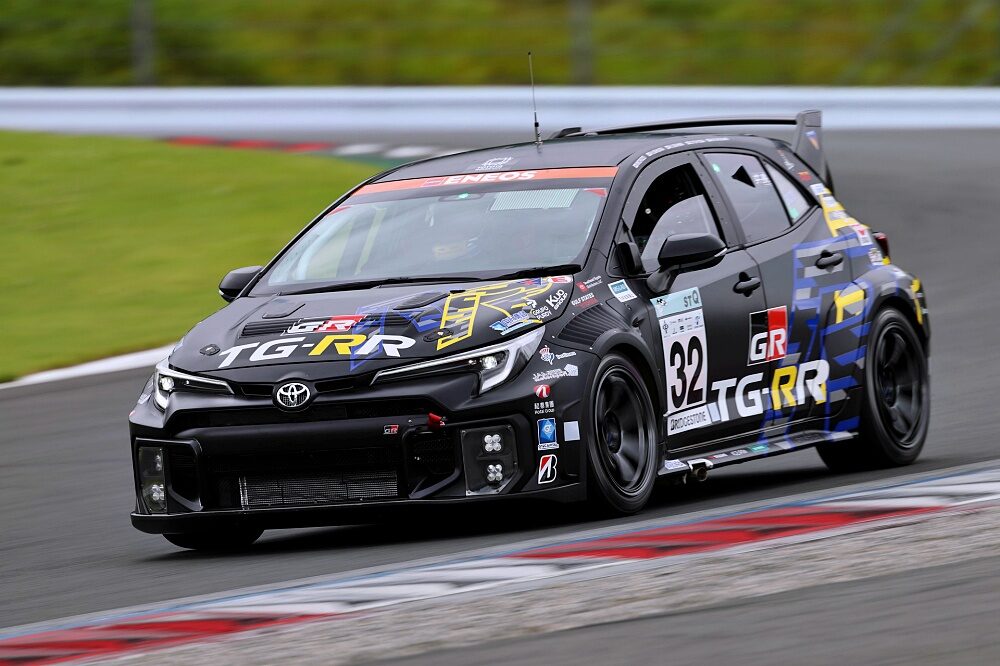
Toyota Motor Corporation will enter the number 32 liquid-hydrogen race car in round three of the ENEOS Super Taikyu Series 2026, the NAPAC Fuji 24 Hours Race. The latest GR Corolla H2 Concept 2026 brings one of Toyota’s most advanced hydrogen-combustion developments to a real endurance-racing environment.
The headline technology is the world first superconducting liquid hydrogen pump fitted to a race car. Toyota will use the 24-hour event to test durability and stability under a harsh continuous-load racing cycle.
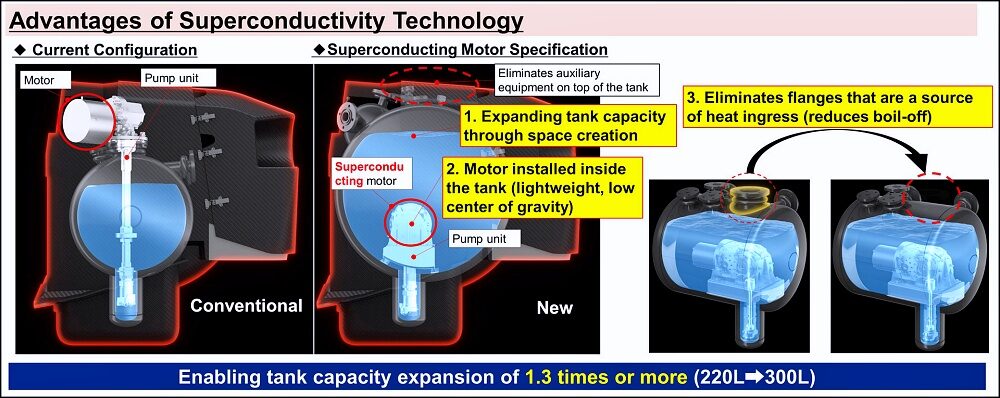
World first superconducting liquid hydrogen pump
Toyota has already moved its hydrogen race-car program from gaseous hydrogen to liquid hydrogen. For this race, the pump drive system is upgraded from a conventional electric motor to a superconducting motor.
The engineering idea is to make use of the extremely cold -253 degrees Celsius environment of liquid hydrogen. Instead of packaging a larger motor outside the tank, Toyota can place the motor within the liquid-hydrogen tank structure and use the cryogenic environment as part of the system advantage.
1.3 times larger tank and lower center of gravity
Moving the large motor from above the tank to inside the liquid-hydrogen tank reduces packaging waste and frees up space. Tank capacity rises from 220 liters in late-2025 competition to 300 liters, or about 1.3 times larger than before.
The second benefit is a lower center of gravity. Relocating a heavy component lower in the car should improve balance and response, which matters especially in an endurance race where consistency over 24 hours is as important as peak speed.
DAT transmission meets hydrogen combustion
Toyota is also pairing its hydrogen combustion engine with Direct Automatic Transmission, or DAT, for the first time. The gearbox has already been tested in gasoline-powered race cars, but this is the first application with Toyota’s hydrogen engine program.
The goal of DAT is to create an automatic transmission that can shift as quickly as, or faster than, a manual gearbox. By removing the need for manual gear changes, the driver can focus more fully on steering, racing line and braking.
The technology also points to a wider motorsport-accessibility strategy. A race car that is easier to drive while remaining quick and precise could bring more drivers into competitive motorsport in the future.
Bangkok Motorhaus Perspective
Toyota continues to argue that the road to carbon neutrality is not limited to battery-electric vehicles. Liquid-hydrogen combustion still has a tangible future, and a 24-hour race is one of the toughest and most credible laboratories for proving that case.
The clever part of the GR Corolla H2 Concept 2026 is the packaging solution. By using a superconducting motor and placing it in the -253 degrees Celsius liquid-hydrogen tank environment, Toyota reduces the motor-heat challenge while freeing enough space to expand capacity to 300 liters. That directly addresses one of the biggest hydrogen-car pain points: driving distance per refuel.
The DAT pairing is equally important. It signals that Toyota is not building this car only as a pure racing technology showcase. The company is moving the hydrogen powertrain closer to production-car usability, where most customers want the ease of an automatic transmission but may still value the sound and mechanical feel of combustion.
If the car survives Fuji 24 Hours strongly, it could preview a next-generation sports-car formula with very low emissions and the spirit of mechanical engines still intact.